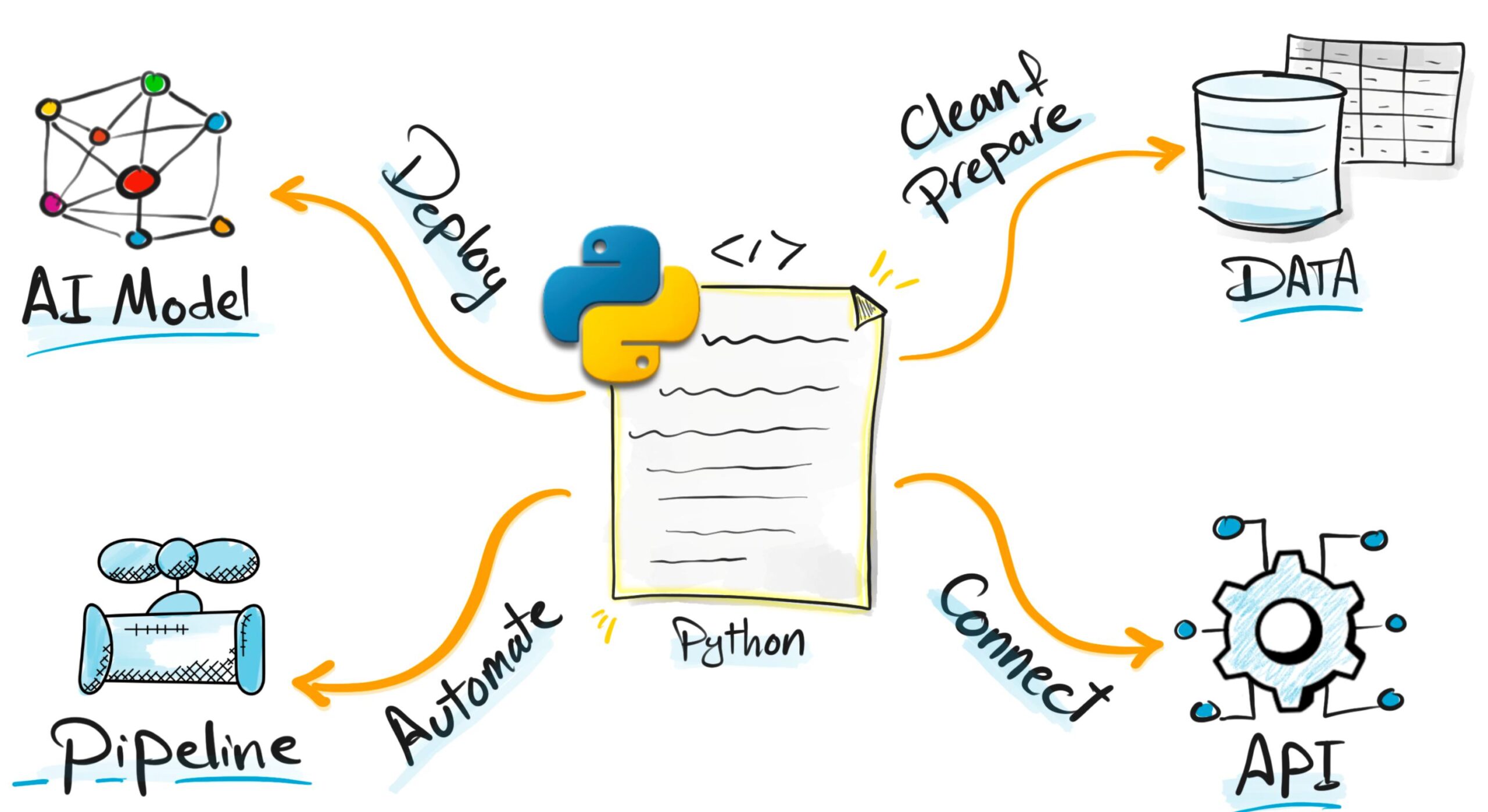
The world of data engineering is changing rapidly.
In 2026, data engineers are no longer focused only on collecting, transforming and storing data. Artificial intelligence is becoming part of the data pipeline itself—helping teams automate workflows, detect problems, improve data quality and build systems that can respond to failures.
At the center of this transformation is Python.
From data processing and automation to machine learning and AI applications, Python continues to connect different parts of the modern data ecosystem.
Data Engineering Is Entering the AI Era
Traditional data engineering typically follows a familiar process:
Data Sources → ETL/ELT → Data Warehouse → Analytics
Modern AI-driven environments are adding another layer:
Data → Pipeline → Quality Checks → AI/ML → Predictions → Automated Decisions
This means data engineers increasingly need to understand not only how to move data, but also how that data supports AI systems.
Recent analysis of 2026 data engineering trends highlights a shift toward greater automation, observability and AI-assisted workflows rather than simply adding more tools to the technology stack.
Python Remains a Core Skill
Python continues to play an important role across the data engineering and AI ecosystem.
It is widely used for:
- Data ingestion
- Data cleaning
- ETL and ELT workflows
- API integration
- Data analysis
- Machine learning
- AI application development
- Workflow automation
- Data quality testing
Popular Python technologies such as Pandas, NumPy, PySpark and scikit-learn allow professionals to work across different stages of the data lifecycle.
Python 3.14, released in October 2025, is the current stable Python release and introduced several important language and runtime improvements, including template string literals and expanded support for subinterpreters.
For aspiring data engineers, Python therefore remains an important foundation rather than a skill that AI is making obsolete.
AI Is Automating Parts of Data Engineering
One of the biggest changes happening in 2026 is the use of AI to assist with repetitive data engineering work.
AI-powered tools can help with:
- Generating transformation code
- Writing SQL queries
- Creating pipeline components
- Detecting anomalies
- Identifying data-quality problems
- Explaining pipeline failures
- Generating documentation
- Optimizing workflows
This does not mean data engineers are becoming unnecessary.
Instead, their role is moving toward designing, validating, monitoring and governing automated systems.
The engineer increasingly becomes the person responsible for ensuring that AI-generated solutions are technically correct, secure and reliable.
The Rise of Intelligent Data Pipelines
Traditional pipelines generally follow predefined rules.
For example:
Extract → Transform → Load
But modern AI-assisted pipelines can introduce intelligent decision-making.
A simplified architecture could look like:
Data Sources
↓
Python / SQL Ingestion
↓
Data Validation
↓
AI-Assisted Transformation
↓
Data Warehouse / Lakehouse
↓
Machine Learning / AI
↓
Analytics & Business Applications
This approach allows organizations to build more adaptable data platforms.
Are Self-Healing Data Pipelines Becoming Possible?
One of the most interesting recent developments is research into agentic self-healing data and AI pipelines.
A paper published in August 2026 proposes an architecture that combines monitoring, pipeline metadata, incident history, deterministic rules, AI-assisted diagnosis and controlled remediation.
The goal is for a system to:
Detect → Diagnose → Repair → Verify → Learn
instead of simply alerting an engineer when something goes wrong.
This is still an emerging area, but it demonstrates where data engineering could be heading: pipelines that are increasingly capable of identifying and responding to operational problems automatically.
AI Is Also Changing How Data Pipelines Are Built
Another emerging research direction involves using large language models to create executable machine-learning pipelines.
Recent research presented LACE, an approach where a language model participates in an evolutionary process that generates complete Python-based pipeline programs. The researchers evaluated the approach across 68 OpenML classification tasks and found competitive results against several established AutoML approaches.
The important idea is not simply that AI can generate code.
It is that AI can increasingly participate in designing complete data and machine-learning workflows.
Data Quality Is Becoming Even More Important
AI systems are only as reliable as the data behind them.
Poor-quality data can result in:
- Incorrect predictions
- Biased AI outputs
- Failed machine-learning models
- Inaccurate dashboards
- Poor business decisions
This makes data quality a critical responsibility for modern data engineers.
AI can help detect unusual patterns and potential data problems, but human oversight remains important for deciding whether a detected anomaly is actually an error.
The Modern Data Engineer Skill Set
The data engineer of 2026 needs a broader skill set than traditional ETL development.
Core Skills
Programming
- Python
- SQL
Data Engineering
- ETL/ELT
- Data pipelines
- Data modeling
- Data warehouses
- Data lakes and lakehouses
Big Data
- Apache Spark
- PySpark
- Distributed processing
Cloud
- AWS
- Microsoft Azure
- Google Cloud
Orchestration
- Apache Airflow
- Workflow automation
AI & Machine Learning
- Machine learning fundamentals
- Generative AI
- LLMs
- AI-assisted development
Data Quality & Observability
- Data validation
- Monitoring
- Pipeline observability
- Data governance
This combination is creating a new profile: the AI-ready Data Engineer.
Python + AI + Data Engineering: A Powerful Combination
For students entering the technology industry, the combination of these three areas can provide a strong foundation:
Python
Build the programming and automation foundation.
↓
Data Engineering
Learn how to collect, process, transform and manage large-scale data.
↓
AI & Machine Learning
Learn how data is used to build intelligent applications.
↓
Cloud
Learn how modern data and AI systems are deployed at scale.
This creates a pathway toward roles such as:
- Data Engineer
- AI Data Engineer
- Machine Learning Engineer
- Data Platform Engineer
- Analytics Engineer
- AI/ML Platform Engineer
- Data Scientist
What Does This Mean for Future Careers?
The demand for AI applications is increasing the importance of the infrastructure underneath them.
AI models need:
Reliable data + scalable pipelines + quality controls + computing infrastructure + monitoring
Data engineers are responsible for much of this foundation.
As AI adoption expands, professionals who understand both data engineering and AI can position themselves at an important intersection of the technology ecosystem.
The Future Is Not Just AI — It Is AI + Data
Artificial intelligence may receive most of the attention, but behind every successful AI system is a data infrastructure capable of supplying reliable information.
That is why data engineering is becoming increasingly important in the AI era.
Python provides the programming foundation.
Data engineering provides the infrastructure.
AI provides the intelligence.
Together, they are creating a new generation of intelligent data platforms.
Final Takeaway
The future of data engineering is becoming increasingly intelligent, automated and AI-driven.
The data engineer of tomorrow will not simply build pipelines.
They will design systems that can process data, detect problems, support AI models, automate workflows and increasingly respond to failures intelligently.
For students and IT professionals planning their next career move, learning Python + SQL + Data Engineering + Cloud + AI can be a powerful way to prepare for this evolving technology landscape.
Python builds the foundation.
Data Engineering builds the pipeline.
AI builds the intelligence.
And the combination is shaping the next generation of technology careers.