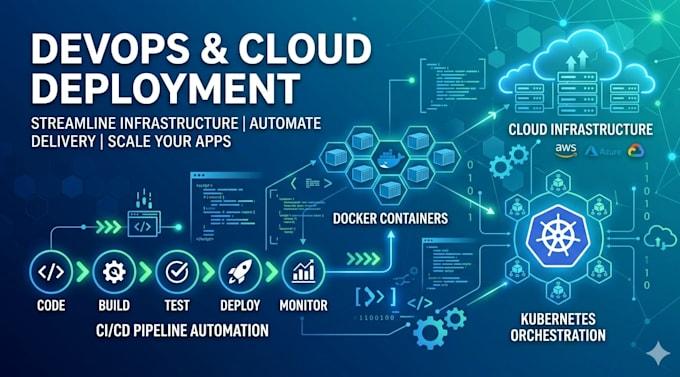
DevOps is entering a new phase. What started as a culture focused on collaboration between development and operations has evolved into a broader engineering discipline involving automation, cloud-native infrastructure, security, observability, platform engineering, and artificial intelligence.
In 2026, organizations are increasingly looking beyond traditional CI/CD pipelines. The focus is shifting toward building intelligent, secure, scalable platforms that allow developers to deliver software faster while reducing operational complexity.
The Evolution of DevOps
Traditional DevOps focused heavily on:
- Continuous Integration and Continuous Deployment
- Infrastructure as Code
- Automated testing
- Containers
- Cloud infrastructure
- Monitoring and logging
These practices remain essential, but modern engineering teams are now dealing with increasingly complex environments involving Kubernetes, multi-cloud infrastructure, AI workloads, security requirements, and rapidly growing application architectures.
According to CNCF’s 2026 research, the global cloud-native developer community has reached approximately 19.9 million developers, while platform engineering and internal developer platforms are increasingly shaping how developers interact with infrastructure.
This evolution is giving rise to a new generation of AI-powered DevOps and Platform Engineering.
1. AI Is Transforming DevOps
Artificial intelligence is becoming an important layer across the DevOps lifecycle.
AI-assisted tools can help teams:
- Generate and review code
- Create test cases
- Analyze CI/CD failures
- Detect anomalies
- Summarize logs
- Assist with incident investigation
- Recommend infrastructure changes
- Automate repetitive operational tasks
However, AI does not eliminate the need for DevOps engineers. Instead, it changes their role from manually managing repetitive tasks toward designing, governing, securing, and supervising automated systems.
Recent industry research also shows that mature DevOps practices remain important for successful AI adoption. Perforce’s 2026 State of DevOps research found that 70% of organizations surveyed believe DevOps maturity materially affects AI success.
2. Platform Engineering Is Becoming a Major DevOps Focus
One of the biggest developments in modern DevOps is the rise of Platform Engineering.
Instead of asking every developer to understand Kubernetes, Terraform, cloud networking, CI/CD systems, security tools, and observability platforms, organizations can create an Internal Developer Platform (IDP) that provides standardized self-service workflows.
Developers can then focus on building applications while the platform team manages the underlying complexity.
Think of it as:
Traditional approach:
Developer → Kubernetes → Terraform → Cloud → Monitoring → Security → Deployment
Platform Engineering approach:
Developer → Internal Developer Platform → Automated Infrastructure
This approach improves developer experience while creating greater consistency across teams.
A 2026 Perforce platform engineering report found that 73% of mature platform engineering organizations surveyed considered platform maturity a critical or significant factor in AI success, compared with 44% among less mature organizations.
3. Kubernetes Continues to Power Cloud-Native Infrastructure
Kubernetes remains one of the most important technologies in the DevOps ecosystem.
Its role is expanding beyond traditional application deployment as organizations increasingly use Kubernetes for AI and machine-learning workloads.
CNCF’s 2026 survey reported that 66% of organizations hosting generative AI models use Kubernetes for some or all of their inference workloads.
For DevOps professionals, this makes Kubernetes knowledge increasingly valuable alongside:
- Docker and containers
- Helm
- Infrastructure as Code
- Cloud platforms
- GitOps
- Observability
- Security
4. DevSecOps Is Becoming Non-Negotiable
Security can no longer be treated as a final step before production.
Modern DevOps pipelines increasingly integrate security from the beginning of the software lifecycle.
A modern DevSecOps workflow may include:
Code → Security Scan → Build → Test → Container Scan → Deploy → Monitor
Security practices can include:
- Static Application Security Testing (SAST)
- Dynamic Application Security Testing (DAST)
- Dependency scanning
- Container image scanning
- Secrets detection
- Infrastructure security checks
- Kubernetes security policies
- Software supply-chain security
The goal is simple: find and fix security problems before they become production incidents.
5. Observability Is Becoming More Important
As systems become distributed, traditional monitoring alone is not enough.
Modern DevOps teams increasingly rely on observability to understand what is happening across applications, infrastructure, containers, networks, and AI workloads.
Observability commonly combines:
- Metrics
- Logs
- Traces
- Events
- Application performance data
OpenTelemetry and cloud-native observability platforms are becoming increasingly important as organizations manage complex distributed systems.
Recent research on SRE and platform engineering also highlights the growing importance of observability as organizations scale AI workloads.
6. GitOps and Infrastructure Automation
GitOps continues to strengthen the connection between software development and infrastructure management.
With GitOps, infrastructure and application configuration can be maintained as code and managed through version-controlled workflows.
A simplified workflow looks like:
Developer → Git Repository → CI Pipeline → Container Registry → GitOps → Kubernetes → Production
Tools such as Argo CD and Flux help automate Kubernetes deployments while maintaining a version-controlled source of truth.
This improves:
- Deployment consistency
- Auditability
- Rollbacks
- Collaboration
- Infrastructure management
What Does This Mean for DevOps Engineers?
The DevOps engineer of 2026 needs more than knowledge of a CI/CD tool.
A modern DevOps skill set increasingly includes:
Cloud + Linux + Networking + Containers + Kubernetes + CI/CD + Infrastructure as Code + GitOps + DevSecOps + Observability + AI
The most valuable engineers will be those who understand how these technologies work together rather than treating each tool as an isolated skill.
The Future of DevOps
DevOps is not disappearing because of AI.
It is evolving.
The next generation of DevOps will combine:
AI + Automation + Platform Engineering + Kubernetes + Security + Observability
Organizations that successfully combine these capabilities can build faster, more reliable, and more secure software delivery environments.
For aspiring IT professionals, this creates a major opportunity. Learning DevOps today is no longer simply about learning how to build a Jenkins pipeline. It is about understanding how modern applications are developed, deployed, secured, monitored, and operated at scale.
Final Thoughts
The future of DevOps is moving from tool-based automation to intelligent engineering platforms.
As AI workloads grow and cloud-native development becomes more widespread, DevOps professionals will play a critical role in building the infrastructure and platforms that make these technologies reliable and scalable.
The DevOps engineer of tomorrow won’t just manage infrastructure — they will engineer the platform that enables the entire organization to build and deploy software.